Connect with us

CHN+

Quarantine Avalanche Storytime: The scary week the team almost lost Joe Sakic to the Rangers

Published

on

Wikimedia Commons

While we all stay home and practice social distancing, another in a series of stories of the Avalanche’s past to help pass some of the time.

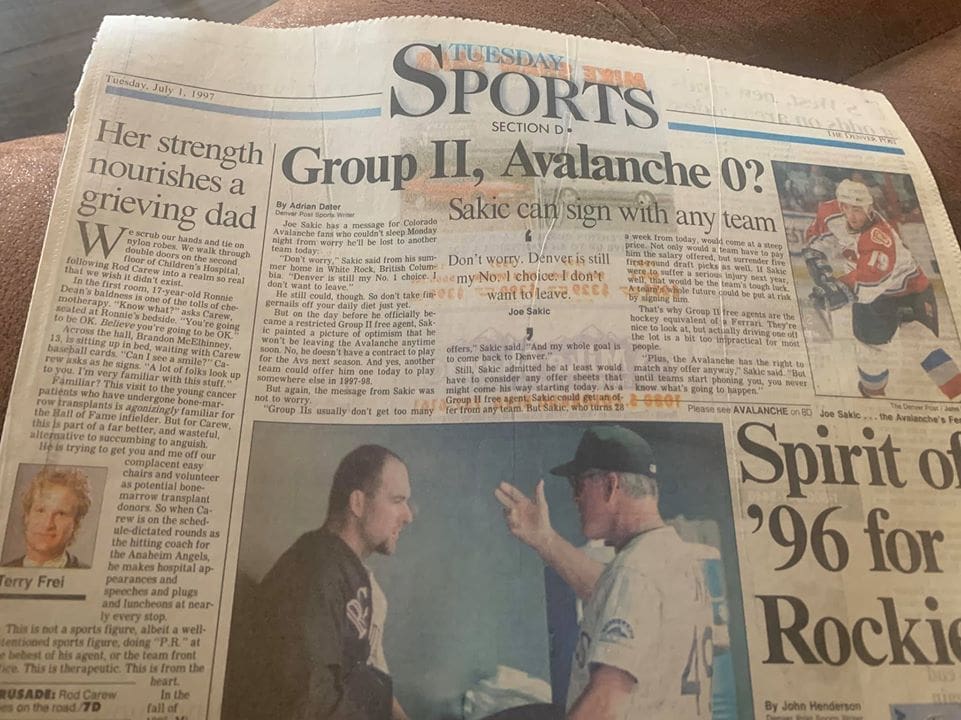
I hadn’t seen this article (see pic above) probably since the day I put it in a bin and closed the lid on it, some 23 years ago almost.

If you zoom in, you can see some of the quotes Joe Sakic gave to me, over the phone from his off-season home in White Rock, British Columbia.

“Don’t worry. Denver is still my No. 1 choice. I don’t want to leave,” he said.

The date on this newspaper is July 1, 1997. Starting that day, teams were eligible to make offers to free agents, something Sakic could be in the “Group II” category (we call them just “restricted free agents today). Sakic said not to worry, that he didn’t think he was going anywhere. And for more than a month, nothing happened. Teams knew that, as part of the Group II rules, any team had one week to match the offer for such players, and with no salary cap back then, teams didn’t worry too much predatory offers like that. Besides, teams always traded such players before they could get to Group II status, if they were worried they wouldn’t be able to afford them anymore.

But on July 28, the hockey world was rocked when the New York Rangers lost Mark Messier as a pure unrestricted free agent to the Vancouver Canucks, to a three-year, $18 million deal.

The Rangers saw Sakic – one season removed from winning a Stanley Cup and Conn Smythe with the Avs – and looked to him to fill Messier’s void. Contrary to belief at the time, the Avs’ ownership group of Ascent Entertainment Corp. was having some liquidity problems, as the pay-per-view movie business in hotels (their biggest cash cow at the time) was just starting to face some erosion from this newfangled thing called the Internet. Plus, Ascent was having a lot of red-tape issues with the city of Denver about a planned new arena, which would be called the Pepsi Center. With their own business starting to struggle and delays getting the Pepsi Center built, cash flow was becoming a problem for Avs ownership. The mega-rich Rangers looked to exploit that with an unprecedented corporate raid of an offer.

On August 7, the offer was made by fax from the Rangers to the Winnipeg-based office of Sakic’s agent, Don Baizley. Three years, $21 million. But here was the kicker: a $15 million signing bonus, up front.

The Avalanche’s entire payroll for its 1996 Stanley Cup-winning team was $16 million. Think about that for a minute. Rangers president Dave Checketts was the mastermind behind the plan, who thought this would work for the Rangers. The cash-strapped Avs, Checketts thought, wouldn’t be able to afford this deal – especially that $15 million check, which would have to be paid to Sakic after the one-week “match it or else” time was up.

In my book “100 Things Avalanche Fans Should Know and Do Before They Die, Sakic told me his reaction to the offer sheet was: “Well, I think I’d be pretty dumb to turn that down.”

So, Sakic signed it. It was a binding contract. He was going to make $17 million for the 1997-98 season ($2 million base salary, with the $15 million bonus) no matter what. The only question, during the week of Aug. 7-14 was: who would be paying it, the Rangers or the Avalanche?

When I went over my own notes on this story, and would soon have it confirmed when all was said and done at the time, I  remember being never too worried the Avs wouldn’t match the offer. He was the captain of the team, in his prime.

Last year, in a New York Post story, former Rangers GM Neil Smith admitted he was never optimistic his team would land Super Joe either.

“As soon as Mark left, Dave wanted to sign Sakic. I told him they’d never let him go, they’d match no matter what,” Smith recounted to the Post. “But Dave said, ‘Trust me, they have no money, they’re broke, bleeding money because of their NBA team. He thought that if we front-loaded the deal, there’d be no way they could match. So we came up with the $15 million up front just to make sure in a preemptory strike.”

While there was some initial worry at Ascent at how they would come up with the $15 million and all the ramifications of what it might do to the rest of their payroll (remember, this was a very good team with lots of young players who would be due new deals before long), it soon became apparent that they’d be able to match the offer. IT wasn’t without some pain, though. Ascent had to sell a 6-percent equity stake in the Pepsi Center to Liberty Media, a Denver-based cable giant at the time. Peter Barton, the No. 2 man at Liberty at the time, worked out the deal with Ascent CEO Charlie Lyons. Liberty essentially gave Ascent the $15 million right then and there for the future equity stake in the Pepsi Center (I think that deal was paid off and/or rectified when Stan Kroenke bought the Avs, Nuggets and Pepsi Center all in one package in 2001).

“I don’t want to say, ‘I knew,’ but I knew,” Smith told the Post. “I knew exactly what would happen, even while everyone in ownership was telling me I was wrong. I knew it wouldn’t work. Even if it looks like you can’t afford to match, no NHL team can afford not to match. It would be choosing money over competing. If you do that, how are you going to sell your product? No team can do that.”

“As sure as I’m sitting here today, I knew as soon as we did it [with Sakic] that everybody would be pissed off at us, and they were,” Smith said.

“I never got the feeling it was personal against me, and in fact, Gary Bettman told me a number of times that he knew that the decision had come down from Dave and ownership and that he had no problem with me.

“Those rumors about Gary blackballing me from the league because of Sakic weren’t true. But there was a lot of resentment against the Rangers. I don’t regret what I did, I gave them my best advice that it wouldn’t work, but I regret that ownership made us do that.”

On the night of Aug. 14, 1997, Avalanche general manager Pierre Lacroix drove to Sakic’s house and presented him a cashier’s check for $15 million. At the time, Sakic became the highest-paid player in all of pro sports.

Joe Sakic

When the offer was matched, Lyons, who worked as an aide to former New York governor (and, later, U.S. vice president) Nelson Rockefeller, sent a framed photo of Rockefeller’s famous one-fingered salute to political hecklers in 1976.

Over the years, I’ve occasionally brought up with the man himself the subject of Sakic signing that offer sheet. In the few years after it, he didn’t like to talk about it much at all. It was always a little uncomfortable for the modest, team-first, humble-origins Sakic to talk about getting a $15 million check and suddenly becoming, by a wide, wide margin, the highest-paid player on the team.

As crazy money like that has become more and more commonplace, with the numbers just so astronomical now by comparison, Sakic isn’t as sheepish about it. His basic attitude is “Hey, they made me an offer I couldn’t refuse.”

Heck, that contract looks almost quaint by comparison to today, right?

There’s more to this story, about how Harrison Ford’s “Air Force One”, financed by Beacon Pictures, an in-house subsidiary of Ascent, also helped not only the Avs keep Sakic, but kept the team afloat until the Pepsi Center arrived. Maybe I’ll do that in another Storytime soon.

Stay safe out there, wash those hands. I want to tell stories about current Avs players again.

Don't Miss a Post!

Enter your email address to get all of our posts in your inbox!

Colorado's premier coverage of the Avalanche from professional hockey people. Evan Rawal, Editor-in-Chief. Part of the National Hockey Now family.

This site is in no way associated with the Colorado Avalanche or the NHL. Copyright © 2023 National Hockey Now.