Colorado Avalanche
Book Excerpt: The Joe Sakic/New York Rangers saga
Hey, it’s the off-season, and while we’ll have plenty of coverage on the draft next month (Oct. 6-7, done virtually) and free-agency (signing period starts Oct. 9) and anything else Avalanche-related, there are going to be some slow days. Good thing I’ve written a few books and can excerpt some chapters for all you paying subscribers, right? Today, I want to post the first of several excerpts from my 2016 book, “100 Things Avalanche Fans Should Know and Do Before They Die.”
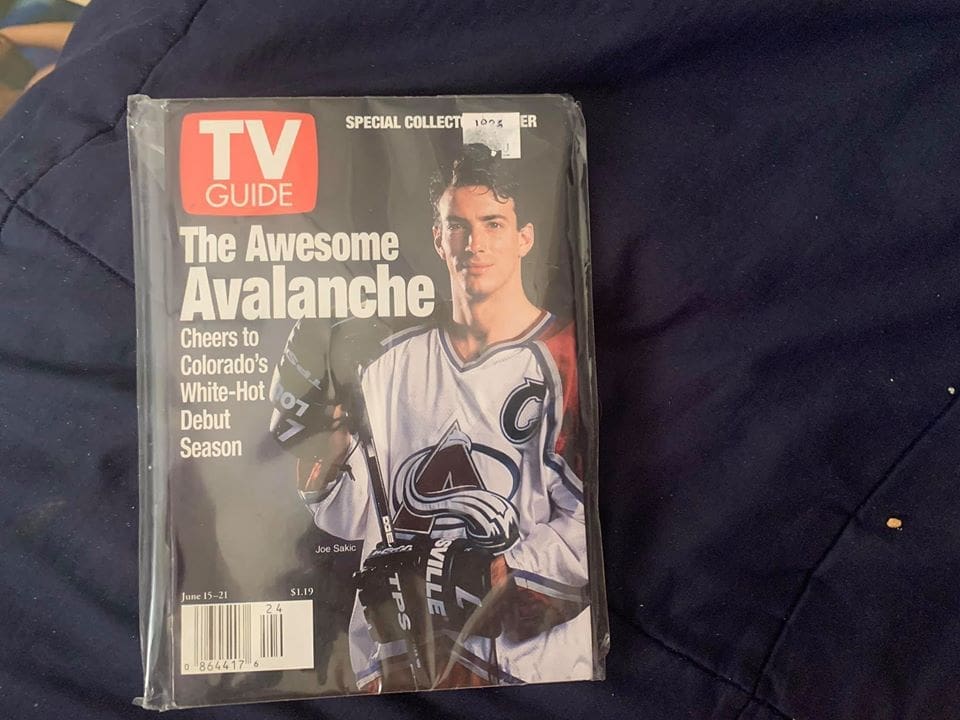
In today’s excerpt, the first of two and the second of which will post tomorrow, we delve into the Joe Sakic/New York Rangers situation from 1997. Sakic really did sign a contract with the Rangers in July of 1997, and it created lots and lots of drama.
Here is the excerpt:

On July 28, 1997, the New York Rangers—only three years removed from winning their first Stanley Cup since 1954—lost their captain, their best player, and their heart and soul in veteran center Mark Messier. The Vancouver Canucks swooped in and stole Messier away with a three-year, $20 million free-agent contract. Nearly 10 days later, on August 7, the Rangers shocked the hockey world by offering Joe Sakic a three-year, $21 million contract as a Group 2 restricted free agent. Under the rules of the NHL at the time, the Avs had the option of either matching the offer down to the final dotted i and crossed t or accepting a raft of draft picks from the Rangers as compensation.
With a payroll that was only $16 million for their Cup-winning team of 1996, this was a serious hand of poker played at the Avs by the deep-pocketed Rangers. At an average of $7 million a year, this would be far and away the largest salary of any player on the team, which to that point was Patrick Roy at a little more than $4 million per. In fact, it would make Sakic the highest-paid player in the NHL, guaranteed. There was a big catch to the contract too: $15 million of it would be paid upfront in one gigantic check as a signing bonus.
The Avalanche’s entire Stanley Cup payroll of $16 million would have to be nearly matched in one signed Charlie Lyons check within seven days if they were to keep their 28-year-old captain and recent Conn Smythe winner. The Rangers structured the deal in a way they thought Lyons and Ascent wouldn’t be able to match. The Avs had a great team, but they’d already shown signs of not being able to keep their financial house in order. The fact was, Ascent was not a very deep-pocketed company in relation to most team owners. Their No. 1 stream of revenue was receipts from hotel room movie rentals, and even in 1997 the smart computer people could see the writing on the wall that such a business’s salad days would be numbered because of broadband technology.
This happening in August, I was caught completely unaware of the offer. Hockey reporters like me usually don’t work much in August. The deal with most newspapers, at least in the older days, went something like this for beat reporters: We’d work at least five days a week during the season, and usually more than that. Anything beyond five days worked technically would put one day of comp time in our bank, and we’d take that comp time, plus our regular one to four weeks of vacation, in the summer months. Essentially, we’d get most of the summer off, with pay, as a winter sport beat writer at a big paper. It was good work if you could get it. At the time, I lived in jealousy of the reporters at the Rocky Mountain News because of their pay system.
Not only did News reporters get a comp day added to their personal account for anything beyond five days, they also got a day of overtime pay. Oh, and the News’s expense account system was a beauty. At the Post, we had to have a receipt for anything more than $10 spent on the road or elsewhere using company funds. No receipt, no reimbursement, and I lost a lot of receipts in my day. The News only required a receipt for anything more than $75. That meant that, wink wink, you could have a meal for $74.99 and not provide a receipt—and still get reimbursed for it! All News reporters had to do was say, “Yeah, um, dinner for $74” or “Cab to church, $74” and they’d get a reimbursement check for that very amount without having to account for it. (No wonder Scripps Howard, their owner, lost big-time money on the paper.)
Compounding Ascent’s money problems at the time of the offer sheet was a mass of red tape that was bogging down construction of the planned Pepsi Center, which would wipe away any cash-flow problems with more than 100 luxury suites that had already been presold. The Pepsi Center and the two Denver winter pro sports teams, the Avs and Nuggets, would be sold to former Memphis State college basketball star Bill Laurie and his Walmart heiress wife, Nancy Walton, in a combined package for $400 million. But Ascent still was haggling with the City of Denver over lease terms and other sticking points, and in the meantime Ascent was on the clock to try and come up with $15 million in cash to hand over to Joe Sakic if they wanted to keep him.
Avs GM Lacroix always liked to drive a hard bargain over contracts, but he very nearly burned a bridge with Sakic when negotiations toward a new deal started early in the summer. Lacroix gave Peter Forsberg a nice three-year $18 million contract before Sakic had gotten a new deal. Lacroix’s best offer to Sakic, as July got closer to August, was four years at $20 million. Sakic had just come off mediocre playoffs that spring, so maybe his market value had gone down some in Lacroix’s estimation.
Either way, Sakic wasn’t amenable to the offer. Though he was never ruled by money as a player, he felt he should still be paid more than Forsberg. Certainly, he shouldn’t be earning $1 million less per year. He had several outstanding years already on his résumé, with a record-setting Conn Smythe performance in 1996. Forsberg, as great as he already was, still was just a fourth-year player. Then came the surprise offer. The Rangers called Sakic’s agent, Don Baizley, to inform him a formal offer would be coming his way via fax. Baizley was stunned when he saw the numbers, and quickly phoned Sakic. Sakic later recalled his response to Baizley was, “Well, I think I’d be pretty dumb to turn that down.”
What happened after that has always been cloaked in a bit of mystery, but not the main points, which are: Ascent quickly signed over a 6 percent share in the Pepsi Center to Liberty Media, a local Denver cable and media giant at the time, in exchange for the $15 million in cash to keep Sakic. Peter Barton, the No. 2 man at Liberty, essentially formulated the deal with Lyons. Four years later, Barton died of pancreatic cancer. The Denver Post caught the scoop on all the major particulars of the deal a day in advance. Mike Monroe, the Nuggets beat writer, and I worked in tandem to break the news on the top of page 1A. I still remember Mike walking up to me quietly before the press conference announcing what already was in our paper and saying, “Uh, we nailed it.” By the last of the seven days, with the financing they’d need secured, the Avalanche gave their response to the Rangers in a most unique way. Along with a fax saying they would match the offer and Sakic wouldn’t be going anywhere, the Avs sent over a framed picture of former Democratic presidential nominee Nelson Rockefeller’s famous one-fingered salute to hecklers on a campaign stop in upstate New York, as a Vice Presidential candidate, in 1976.

Lyons, a former intern for Rockefeller in Washington, delighted in sending the photo to Rangers GM Neil Smith and president Dave Checketts. At one point during the week, during a conversation on the phone I had with Sakic, he said he would have been excited to play with his boyhood idol, Wayne Gretzky, and that the schools in New York were presumably as good as those in Denver for his young kids. But when the Avs matched the offer, Sakic, ever the diplomat, smiled and said he’d be happy staying where he always wanted to stay. Of course, those 15 million new reasons didn’t hurt his affinity for Denver either.
There was another unlikely source of income that helped keep Sakic with the Avalanche, which we’ll get to in our next chapter…