
 Adrian Dater
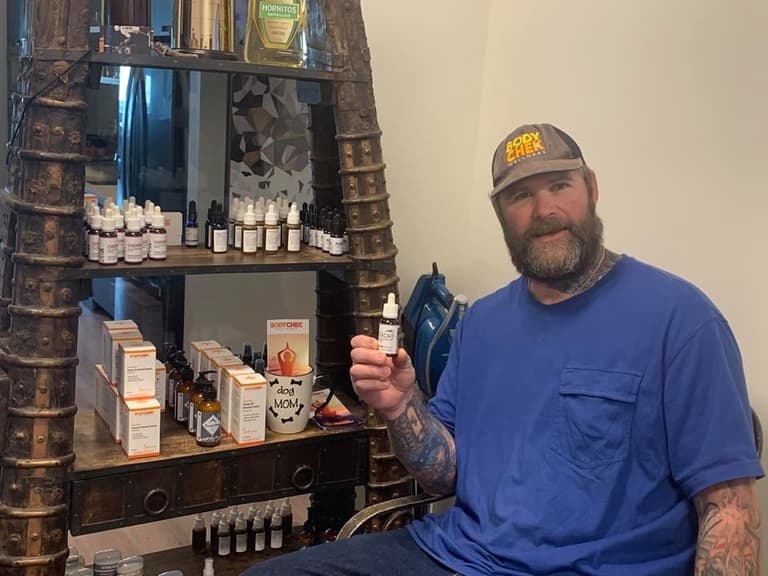
CASTLE ROCK – He doesn’t wake up puking his guts out every morning anymore. He doesn’t have to wear sunglasses all the time, even indoors, like he used to. The life-threatening seizures that would frequently hospitalize him haven’t happened for two years now. His eyes, which once had a glazed, faraway look to them, seem clear and focused.
Scott Parker is kicking life’s ass again. Once one of the baddest dudes on the ice in the National Hockey League, Parker was knocked down harder than any punch he ever took by concussion symptoms that all started with a loose puck to the head. His post-hockey life, after a career that saw him play for the Avalanche and San Jose Sharks, became an intolerable witch’s brew of pain, depression and despair. Many around him, most especially his wife, Francesca, and son, D.J., feared he would die the same kind of tragic death too many other bare-knuckle hockey fighters and other athletes have in recent years.
“We almost lost him a couple of times,” says D.J., sitting next to his parents on Tuesday afternoon. “It was close.”
But thanks to the cannabis plant, specifically the part that is called CBD (not the other part that gets you high), Parker says life is good again. Not good, great. While he’s not out playing pickup hockey all night or running marathons, Parker today is living a busy, active, entrepreneurial life in Castle Rock.
After experiencing how CBD oils and extracts helped the concussion symptoms lift and the seizures disappear, Parker became such an evangelist for the cannabinoid that he started his own CBD company – BodyChek Wellness – along with former NHL player Riley Cote.
I know what some of you cynics are thinking: An ex-player is jumping on the CBD Bandwagon, hoping to make a quick buck off a product that has yet to gain approval from the Food and Drug Administration and whose efficacy is questioned by some in biology and science. While it is not on a banned list of substances in the NHL, players are tested for cannabinoids in the league’s Substance Abuse and Behavioral Health Program, and is discouraged as an official remedy for pain. If a high enough level of CBD and/or THC (the part of the plant that gets you high) is found on a test, players can be ordered to see a doctor.
Which is hugely ironic to Parker, who says none of the things doctors in the NHL officially gave him to treat concussion symptoms and any other pain did a damn thing. His friend and sometimes sparring partner when they both played in the NHL – Cote – told him to try CBD, that it helped him overcome some of the same problems.
“What have I got to lose?” Parker thought. But like everything else that was supposed to have cured him, Parker had his doubts about CBD. But then, after a week or so, he felt a little better. Another week, a little better. Another week, a little better.
Today, Parker speaks with clarity and rapid-fire cadence, a far cry from the man whose speech sounded slurred at times a few years ago.
“Athletes, and people in general, really need an alternative to the opioid epidemic that’s going on. Having something that actually makes you feel better, rather than something that’s just masking the pain,” said Parker, 41, a member of the Avalanche’s Stanley Cup team of 2000-01, whose career ended in 2008. “People have to be more aware of what they’re putting in their bodies. You can’t have things that are really addictive, and all these really expensive pills where you don’t know if they’re really working or not and you have to mortgage your house to get. Cannabinoids work hand-in-hand with our bodies. We’re just trying to get the word out.”
Parker calls CBD his “Apres”, as in “Own your after.”
In that vein, he sounds just like other ex-athlete CBD evangelists such as Rob Gronkowski, Mike Tyson, Jim McMahon, Darren McCarty, Daniel Carcillo, Ryan Vandenbussche and Cote.
“This product really helped me. If I can pass it along to others, to say ‘hey, try this’, maybe we’re going to save someone else from spiraling down the hill like I did for a while,” Parker said.
Francesca Parker, a former police officer who has been with her husband for more than 20 years, has a brain tumor. She has lost more than 100 pounds (“I needed to, but didn’t want to like this,” she jokes), partially from the treatments she’s endured. But she says she’s felt much better since trying the high-potency, mushroom and hemp-infused CBD capsules she takes multiple times per day.
“I noticed a huge difference,” said Francesca, whose tumor sits just above an eye, which is why doctors don’t want to operate, but it’s hoped the tumor will not spread. “We have three growers who all have Ph. D’s’. We know what’s in this product. We know how it can help. It’s a hug for the brain.”
The Parkers, along with Cote, like to say their product is “By athletes, for athletes.” But anyone who has known them over the years knows how much they’ve tried to ease the pain of regular people, most especially military veterans who suffer from brain injury and/or other physical trauma. In 2007, the couple started a 501c3 nonprofit called “Parker’s Platoon”, which raises money for wounded veterans. The couple bought a mountain home that they specifically use for wounded veterans who need a place to stay, want to get away from it all or just commune together.
The Parkers hear every day, they say, from wounded veterans who kicked opioids in favor of CBD and who are the better for it.
“I felt like I was just locked up all the time,” Scott Parker says, of his pre-CBD, post-career days. “This has helped me back.”
Parker is not 100 percent free of concussions’ clutches. He is advised not to do any strenuous physical activity. No more playing hockey anytime he wants. No more punching trees with his right hand wrapped in chains, which he did all the time in his NHL days, to toughen up fearsome right.
Here’s the difference since he started taking CBD, he says: It used to be that just getting out of bed was a three-alarm fire to his brain, with any movement or sunlight or noise bringing a recurrence of the pain in his head to which he compared it to a “waterfall of pinpricks.”
“The things I had with my head, it’s like someone who was in a bad car crash,” he says. “It’s similar, but in a little different way. There’s a lot of people who are dealing with stuff they may not know they’re dealing with. A lot of the stuff is undiagnosed. Maybe they can’t see something on the scan. Or, the technology isn’t there to really give somebody the answer. Unfortunately, they just get prescribed all sorts of stuff to try and figure out what works for them, rather than knowing that our bodies are in the cannabinoidal system, so to have cannabinoids go in there and go to the source…it’s amazing how it can almost go there, to almost heal and repair. It’s not like a masking agent, where you put something on there really hot, then you don’t feel it, but you’re really just making it worse and before you know it, you’ve got a complete tear.”
Parker knows about the skeptics. He knows many people call CBD a modern version of “snake oil.”
“We want to deal in facts. We don’t want to assume or just have an opinion,” Parker said. “The facts that we’ve had so far are really just our testimonials. But we’ve had these testimonials from veterans, from cancer patients, from drug addicts. We’re not pushing our brand so much as we’re pushing the health and wellness side of things. We’re just trying to say, ‘hey, take a step back and just know what you’re putting into your body.’ We know that some of the CBD companies out there are snake oil. We know 100 percent what’s going into our products, how many hands are touching our products, how it was bottled, how it was labeled. It’s a family-type of mentality with our business. We don’t want to become corporate, with all those tiers. We want to be able to call our growers, call our distribution place. A lot of companies are “white-labeled”, where they really don’t know what’s in their product and can’t answer questions about it. We’re very engaged in the whole process.”
Cote, who played 156 NHL games with the Philadelphia Flyers, was one of the earliest athlete advocates of CBD. He founded the “Hemp Heals Foundation” and is a board member of the Pennsylvania Hemp Industry Council.
“This is not a scam, this is not a money grab,” Cote told me, via cell phone Tuesday. “There’s no chance I would push a product that I knew, deep down inside, was bad for you. ‘Parks’ is the same way. He isn’t out to make money off this. He wants to help people. That’s all he and Francesa and D.J. really care about. Sure, we want to grow as a company. But if we grow as a company, it will only be because more people like what our products can do for them. If it’s all just (garbage), then we won’t deserve any growth.”
Says Scott Parker: “I know what so many people are going through right now, with pain and their addiction to opioids and everything around that. There’s no magic cure-all for everything. You still have to be good to your body in so many other ways, not just taking (CBD) and abusing yourself in other ways. But I know how this helped me, I know how it’s helped others. Right now, all I want to do is keep spreading the good word.”
To read the story I wrote nearly six years ago on Scott Parker, for The Denver Post, click here.
To learn more about “Parker’s Platoon”, click here.
To learn more about the BodyChek line of CBD products, click here.