CHN+
A visit with the remarkable Charlie Lyons, the Avs’ first owner
I spent a fair amount of time texting, calling and even FaceTiming a man named Charlie Lyons in the past week, and for you younger readers here at Colorado Hockey Now, he was the first owner of the Colorado Avalanche, from 1995 to 1999. But forgive me if I want to live even more vicariously through Charlie after several talks. You might want to do that, too, when you realize that:
Charlie Lyons not only owned the Avs and the Denver Nuggets for several years, but he became a Hollywood film and television mogul, who lives comfortably in the Pacific Palisades near Malibu, happily married to his wife of three decades, with two healthy and thriving offspring who are in their 20s.
His late mother, Anita, was the first-ever female producer of the long-running CBS weekend news show, Face The Nation. Anita Lyons played a large role in the downfall of the despicable Congressman Joseph McCarthy in the 1950s. When McCarthy went after famed CBS newsman Edward R. Murrow in one of his communist witch hunts, Murrow retreated somewhat in despair, at one point taking refuge in her apartment to lay low. She assured him that the country was on Murrow’s side, and it wasn’t long after that McCarthy’s reign of demagoguery came to a close.
Charlie was a speechwriter as a young man, for former United States Vice President Nelson Rockefeller. He was an executive in the Marriott Corporation. Charlie is an instrument-rated pilot, who owns his own plane and flies it all the time.
Charlie became friends in 1997 with famed actor Harrison Ford, when the film production company Charlie helped found, Beacon Pictures, made the film “Air Force One”, which helped save the Avs in some ways (story about that here). Since then, Charlie’s family and Ford’s family have vacationed together.

Charlie’s production company is heavily involved with the popular television series “Yellowstone” and counts star Kevin Costner as another good friend. He is heavily involved with former Nuggets star Dikembe Mutombo in charitable works in Africa. He is both an investor and an evangelist for health and wellness initiatives, most especially with a company called Vejo.
He is in his late 60s, but looks at least a decade younger. He is smart, articulate and, best of all, not at all weighed down by ego despite all his considerable accomplishments. He remains relentlessly curious about the world and always in search of how to make it a little bit better somehow.
Man, has he got some good stories to tell, especially about how the whole process of how the sale of the Quebec Nordiques to his company – at the time named Comsat Video Enterprises – came about.
I’ve told the story of how the Nordiques were sold and moved to Denver, both on this site and in books. But Charlie filled me in more about how the whole thing really happened.
Really, the Avalanche were always supposed to be an expansion team. No way on God’s green earth did Lyons and his Comsat board members ever think he’d buy a storied hockey team from Canada.
“We had the Nuggets, and the Nuggets had a great playoff run in 1994, with that great series win in Seattle, which remains one of the most transformative experiences of my life,” Lyons said. “But we played in McNichols Arena, and McNichols Arena, we knew, wouldn’t be an adequate facility moving forward into a newer, more technological age of sports. We saw that well in advance.
“But we had another problem: we only had one winter sports team to fill dates at McNichols. What we really needed was a hockey team to be another tenant.”
One day, Lyons got a phone call from another sports executive. His name was Tony Tavares, team president of the NHL’s newest franchise, the Mighty Ducks of Anaheim.
“You might want to explore the possibility of buying the Quebec Nordiques,” Tavares told Lyons. “They’re in some real trouble. I can arrange a phone call with their owner, Marcel Aubut.”
Lyons did call Aubut, a Falstaffian man of many great appetites, but who was in over his head financially with owning an NHL team in a time of rapidly escalating salaries. Lyons told Aubut Comsat would be interested in the Nordiques if he needed to sell, but both men believed at first that the gesture never actually come to an actual deal.
Aubut now had a publicly disclosed suitor, which would put more pressure on the government in Quebec City to help build what was desperately needed even more so there than in Denver: a new building.
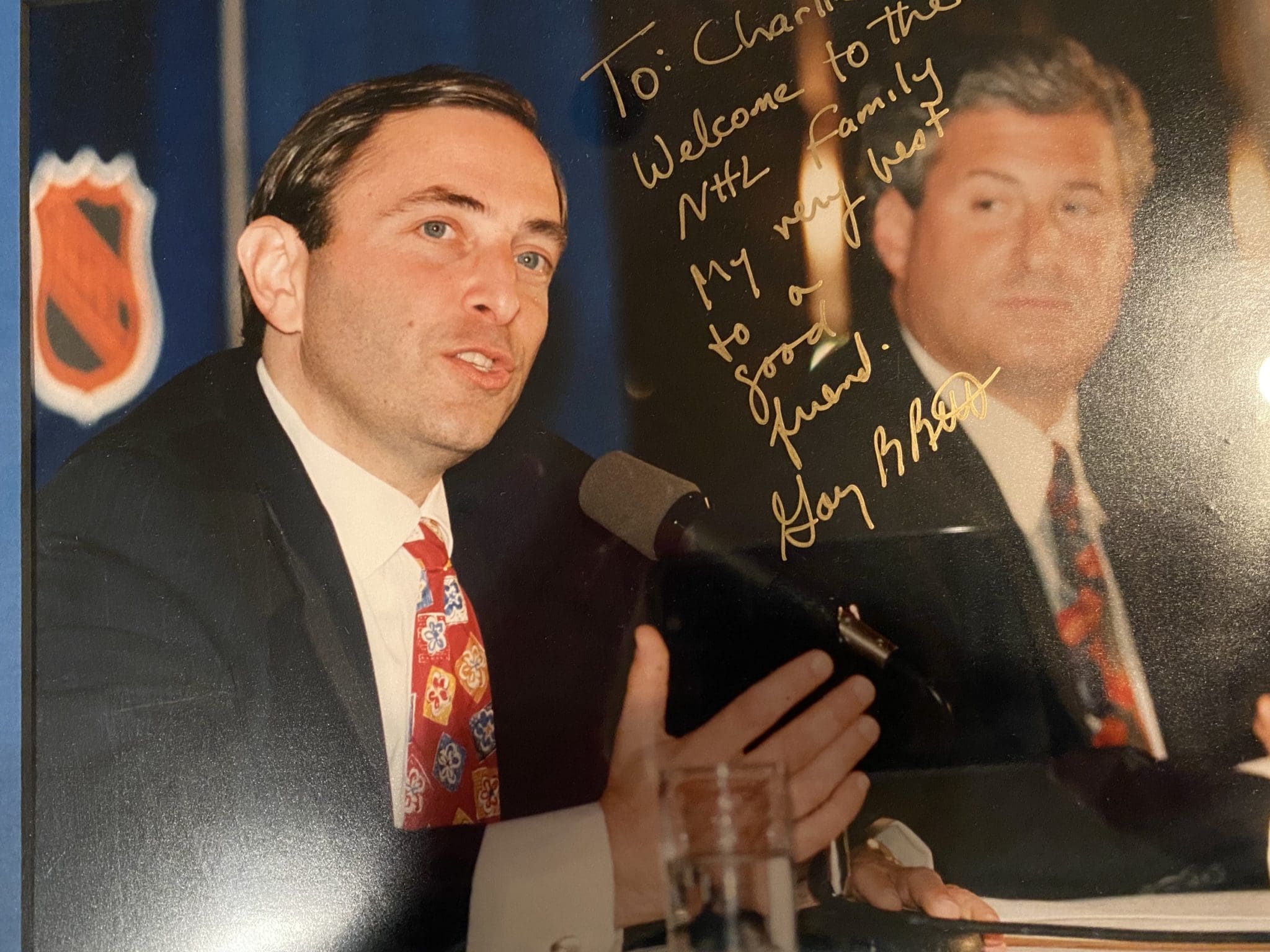
Lyons now was in the good graces of NHL commissioner Gary Bettman, who appreciated the favor of helping out Aubut and the Nordiques, leverage-wise, and might repay it with another anticipated NHL expansion franchise in a year or two. Lyons knew another pro team in Denver would accelerate his ultimate goal, which was to get a new building himself.
For several weeks, both Lyons and Aubut played their roles. Aubut would publicly warn the hockey-mad locals in Quebec that their team might move or else, if he didn’t get his new arena. Lyons sat back from afar, thinking there was only a minute chance he’d actually have to go through with an offer for the team. He’d get an expansion team in a year or two and he’d be able to bide time with the Nuggets and the ever-antiquated McNichols until then.
The two would always dine at the same restaurant, the China Village (later named the Shanghai Village) in Bethesda, Md., where Comsat was based. “Best Peking Duck on the planet,” Lyons says.

“Marcel loved to fly down in his plane and have dinner, and it was always at the same place for Chinese,” Lyons said. “My little 2-year-old son would often come, and he’d be flinging his kid’s plate of Lo Mein at him and we’d just laugh and laugh. Marcel absolutely didn’t want to sell the team, though. It was never assumed, early on, that we’d actually do a deal.”
But the local politics of Quebec City in 1995 were abysmal when it came to the prospect of funding for a new arena. There were teacher shortages and other municipal deficits, and an added tax increase to fund a fancy new arena was ultimately beaten back by a determined group of activists who deemed a hockey team an unnecessary luxury item for already-stretched taxpayers.
What didn’t help matters at all at the time, but was underreported for its significance then: The 1994-95 Nordiques, with rookie of the year Peter Forsberg, some other up-and-coming stars such as Adam Deadmarsh, Adam Foote, Valeri Kamensky, Owen Nolan and established stars such as Joe Sakic and Wendel Clark, breezed to the Eastern Conference regular-season title.
A run to the Stanley Cup – as many predicted would happen – might be just the thing Aubut needed to turn the tide politically toward voting on a new arena – a vote which would have been based on revenue from another proposed new enterprise – a casino. But the Nordiques were beaten in the first round of the playoffs by the New York Rangers.
Aubut no longer had the revenue that a long playoff run would have given him. Despite the Nordiques’ promise as a team, the first-round exit was just another downer on the people of Quebec in a time of economic difficulty. A key, potential leverage point was lost.
“In May of ’95, that’s when things started to get real serious,” Lyons said.
Lyons, though, worried he might too soon be in over his head. Buying the Nordiques would cost the then-princely sum of $75 million.
“It was controversial, even with some members of my board,” Lyons said. “There were some who were very skeptical of buying a team and moving it to Denver, with all the myriad of other things that go into a transaction like that. The safer play might have been waiting for an expansion franchise.”
But Lyons was, and remains, a risk-taker. When Aubut flew to Bethesda one final time in May, he came with advance news: have the papers ready to sign. He had to sell.
“I actually don’t remember much about that day when all the papers were signed. It’s kind of like when you buy a house or a car, and you just have a pile of papers in front of you to sign,’ Lyons said. “But I do remember that Marcel was very emotional. He never, ever wanted to sell that team. He loved that team and the fans of Quebec. He tried everything to save it. And frankly, I remember thinking, ‘Be careful what you wished for. You just got it.’ You know how sometimes you just have to fake it, that you know what you’re doing? Well, that’s how I was feeling then. I didn’t know anything about hockey. But the only thing I did know was: we were supposed to be getting a really good team, right off the bat.”
Yeah, you might say that. A Stanley Cup. In the first year in Denver. A little more than a year after signing the papers with Aubut, Lyons was holding a Stanley Cup over his head, and watching the owner of the Florida Panthers, Wayne Huizenga, do the same (they had a bet on the series, and that was the price for losing) with Patrick Roy – a guy Lyons had barely ever heard of a year before, in the picture as well.

Photo courtesy of Charlie Lyons
“I remember Pierre Lacroix called me one morning and said, ‘Did you see what happened in Montreal last night?’ I said I hadn’t. Pierre said, ‘We can get Patrick Roy, and with Patrick Roy, we’ll win the Stanley Cup. As long as you said it’s OK to do it.’ And I said, ‘yes, yes, do it, do it,'” Lyons said. “The whole thing was just unbelievable. To have been able to bring Denver its first major championship, in the team’s first year, I mean, how does that even happen?”

Pierre Lacroix, with Charlie Lyons’ son, 1996 after winning Stanley Cup (photo courtesy of Charlie Lyons)
The question of a new building kept looming over the team, though. Not just for the Avs, but the Nuggets too. There were innumerable red-tape issues with the city over construction of the planned Pepsi Center. Lyons was starting to feel some of the same pressures Aubut had in Quebec. Lyons, at one point, even thought he might have to sell the Avs and Nuggets and that there was a slight chance both could be moved to other cities. The odds of that actually happening were always very slim, Lyons says, but there were some anxious moments for Comsat – then renamed Ascent Entertaining Group – in the couple years after the Avs won the Cup. Player payroll was rising – the total payroll for the Cup-winning team was just $16 million – but the team was still stuck in the low-revenue, outdated McNichols.
Then came the notorious New York Rangers’ offer sheet to Joe Sakic in 1997, a three-year, $21 million offer that included a staggering $15 million signing bonus. But, as luck would have it again for Charlie Lyons, that was the summer where “Air Force One” was to be released. It proved to be a blockbuster (to date it has grossed about $325 million worldwide) and despite Ascent being in a time of tight finances otherwise, the assurance of a vast revenue stream from the movie made it easier for Lyons and the Avs to match the Rangers’ offer and keep Sakic.
Lyons has remained grateful to Harrison Ford ever since.
“He’s a dear friend. He’s an incredible guy. He has a photographic memory, so he not only can know and see his own lines, he can see everybody else’s on a script. It’s amazing. He knows where everyone should stand, where everybody is supposed to be on the set. He’s always the hardest-working guy on the set too, always,” Lyons said.
At first, the movie was tentatively slated to open around late November. Lyons one day told Ford that news, and Ford wasn’t too happy about it. Ford had assumed it would be a summer release, and he had already booked his personal calendar to do promotion work for the film then. Ford thought it would be a great summer popcorn movie, and in the end he got his way – the film was released in July. And, it turned out, Ford was right; It was a summer blockbuster.
“Harrison was the biggest star in the world and knew his audience,” Lyons said.
Lyons and Ascent would sell the Avs, Nuggets and soon-to-open Pepsi Center in 1999 to Bill Laurie and his wife, in a $400 million deal. Then things got messy. Ascent shareholders thought the price should have been higher and filed suit to block the sale, and the properties were then rescinded by the Lauries – in exchange for $8.2 million – and put back on the market. Denver businessman Donald Sturm won an open auction for the properties for $461 million, but that transaction, too, soon fizzled. The teams and the Pepsi Center were put back on the market, and Stan Kroenke finally came in and bought them for $450 million, and remains the ownership group to this day.
Not surprisingly, Lyons doesn’t love reliving that particular chapter in his life.
“It was stressful. It was a bad time for me personally,” he said. “But you learn from things like that. It taught me some valuable lessons.”
Lyons and his family soon relocated to California, where he got into the film and entertainment business full-time. The last 20 years have been fruitful in every way for him and the family, and today he is the picture of relaxed wellness – but a man who wants to give back as much as he can. He knows, ultimately, he’s lived a very charmed life.
“Denver, Colorado, is still my all-time favorite city,” Lyons said. “I was very, very fortunate to have done some things there. I obviously will always root for the Avs and Nuggets. I do have a little history with them, after all.”