
 Terry Frei
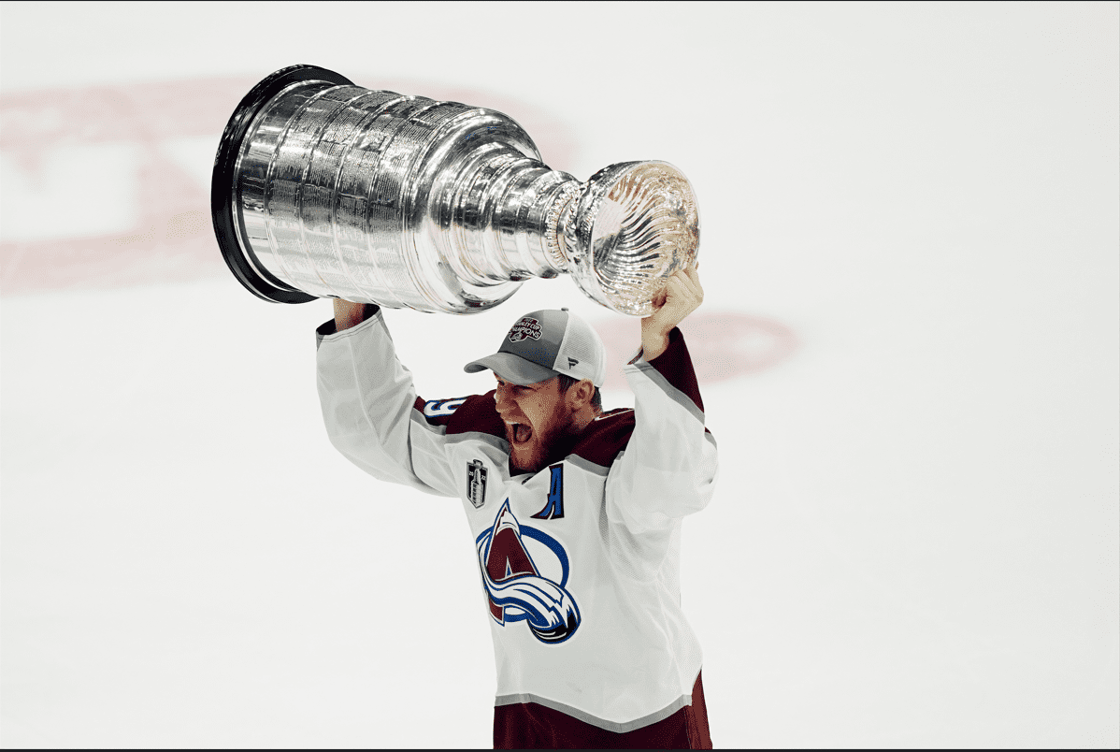
The car horns. The yells. The screams, And so much more.
Beginning at 8:49 p.m. Mountain Time Sunday, the celebration was on.
And that was in Colorado.
(Colorado employers, please be sympathetic Monday morning. Or, come to think of it, maybe you’ll be hurting, too.)
Is it too soon to stake out the spot on the Thursday downtown parade route?
On the Amalie Arena ice 1,900 miles away in Tampa, with Gabriel Landeskog, Nathan MacKinnon, Conn Smythe Trophy winner Cale Makar and the rest of the Colorado Avalanche, the scene was pretty raucous, too.
The Avalanche’s 2-1 closeout win over the Tampa Bay Lightning in Game 6 of the Stanley Cup Final was forged with goals from MacKinnon and Artturi Lehkonen, a solid effort from frequently maligned goalie Darcy Kuemper, and a terrific effort in front of him.
It immediately nudged the Avalanche to a prominent spot in Colorado sports lore.
For the second time this year, Stan Kroenke was on the fringe of a celebratory gathering, again wearing a “Champions” hat. The first time was as the Los Angeles Rams’ owner following their Super Bowl victory; this time was as the owner of the Avalanche. The last time the Avalanche won the Stanley Cup — in 2001 — Kroenke was a “new” owner, settling in, and it was almost as if he still was learning about icing.
I’m convinced the Avalanche won more fans Sunday night. Yes, literally around the world.
It wasn’t only that they won … and won playing an entertaining style that will be trend setting in a copycat league.
It wasn’t only because they got to take turns raising the Stanley Cup, and that’s one of the best scenes in all of sport.
It wasn’t that man after man, they offered touching and giddy reactions on the ABC post-game coverage and sounded like kids fulfilling the hockey dreams so many have had, but so few get to experience.
It was that they won it in style, demonstrating a praiseworthy contrast to the two-time defending Stanley Cup champion Lightning.
The Lightning at times played like stubborn, prideful champions, extending the series to six games.
But their whining — during and after games — was unseemly.
They didn’t act like champions.
I’m not going to run down a list. You saw it. You heard it.
The Lightning’s Jon Cooper is a great coach, the longest-tenured in a league that treats those in that position as if they’re, say, disposable razors. More important, his subdued, enigmatic monologue after Game 4 came off like a woe-is-us concession speech.
Meanwhile, Jared Bednar was poised and classy, refusing to be drawn into the excuse-making and lamenting.
That set contrasting tones.
It was in keeping with Bednar’s rise from journeyman ECHL defenseman, to ECHL assistant coach, to ECHL head coach, to AHL assistant, to AHL head coach … to the Avalanche.
He got to raise the ECHL’s Kelly Cup (ironically, named after Pat Kelly, a former NHL Colorado Rockies head coach I covered as a young scribe) both as a player and coach; and the AHL’s Calder Cup as coach of the Lake Erie Monsters. And now the Stanley Cup.
Specifically, the way the Avalanche closed out the Lightning was an emphatic exclamation point.
After Steven Stamkos gave Tampa Bay a 1-0 lead only 3:48 into the first period, the Avalanche got the second-period goals from MacKinnon and Lehkonen. Then they managed to avoid the temptation to try to sit on the lead — a temptation they’ve been vulnerable to at times.
The Lightning, in theory pressing for the tying goal and hoping to at least get the game to overtime, got four shots on goal in the third. FOUR. The Avalanche didn’t score in the period, either, but they had nine shots. There was no prevent defense in play. And give the guy credit: After allowing Stamkos’ goal through the 5-hole, Kuemper was good enough to get the job done in the Colorado net … and hoist the Cup.
Perhaps I should let the dust settle and the corks be popped, but I’ve covered all three Avalanche Cup champions.
So, yes, even as this season and playoff run progressed, I often have been asked about the relative merits of the 1996, 2001 and 2022 Avalanche teams.
Comparisons are perilous, actually, because the 2005 implementation of the league’s hard salary cap changed the game and made it harder to build a roster, Prior to that, you had a cap, but it was called a “budget.”
Especially the ’01 team was a Hall of Fame roll call as it stepped out of the bus, and those teams had the best goaltender of all time and the best pick-your poison, 1-2 center punch of its era.
Perhaps that ’01 team could beat this ’22 team in a head-to-head series.
But we’ll never know, will we?
At least on Sunday night, I’ll take this ’22 team, which went 16-4 in the playoffs, better than the records in ’96 (16-6) and ’01 (16-7). Can there be consecutive titles or even a dynasty? Those will be monumental challenges, considering Joe Sakic will have a long list of pending unrestricted free agents to deal with.
But for now …
Party on.
Terry Frei ([email protected], @tfrei) is a Denver-based author and journalist. He has been named a state’s sportswriter of the year seven times in peer voting — four times in Colorado and three times in Oregon. His seven books include the novels “Olympic Affair” and “The Witch’s Season.” Among his five non-fiction works are “Horns, Hogs, and Nixon Coming,” “Third Down and a War to Go,” “March 1939: Before the Madness,” and “’77: Denver, the Broncos, and a Coming of Age.” He also collaborated with Adrian Dater on “Save By Roy,” was a long-time vice president of the Professional Hockey Writers Association and has covered the hockey Rockies, Avalanche and the NHL at-large. His website is www.terryfrei.com and his bio is available at www.terryfrei.com/bio.html
His Colorado Hockey Now column archive can be accessed here