
 Aarif Deen
After trading Charlie Coyle to the Columbus Blue Jackets, the Avalanche’s deep center core is now seemingly anything but that.
Colorado has Nathan MacKinnon at the top of the lineup, and that’s not going to change anytime soon. But after that, it gets a little grim. The Coyle trade ultimately removed a lot of the insurance the team had built behind MacKinnon.
Brock Nelson returns as the 2C after signing a three-year, $7.5 million AAV deal. And then there’s Jack Drury — the solid fourth-line center who might be asked to play third-line minutes if nobody else is brought in.
Following the Coyle trade, general manager Chris MacFarland said he prefers Drury as 4C, but wouldn’t mind giving him a look on the third line. Ultimately, the upcoming season is going to help determine where Drury’s future with the club will land. Is he primed to be the 3C the team hoped they were acquiring, or will he always be fighting above his weight class in that position? We shall find out.
But without Coyle, the Avs are missing that added depth that could step in if Nelson struggles. Without Coyle, you’re asking Drury to play a line higher than he should, without really having anyone breathing down Nelson’s neck.
Given how the center market shook out, I’m glad the Avs were able to bring back Nelson. And I do think he’s going to settle in nicely. But what if he doesn’t? Coyle was a great piece to have as added depth, even if I agree with why they traded him.
Anyway, back to that 3C hole. How are the Avalanche going to solve it? And more importantly, when? I’m not sure if many teams are willing to part with a solid third-line center at this point. Not until they begin the season and determine if they’re ready to compete for a playoff spot.
So does that make this a mid-season move? Maybe. But even if so, I will say, it’s easier to acquire a 3C than a 2C in the middle of the year. Especially if you’re targeting teams looking to restock with future assets. So this would at least be a simpler task than what the front office has had to deal with in each of the last two years.
With that being said, here are seven trade targets the team could look at to help complete their center depth.
Just keep in mind, these aren’t all necessarily pieces that are available now, nor am I implying that they ever will be. I’m playing the long game with this one and trying to identify guys who might be available now, or during the year if their team flops to start the season.
Use promo code Deen10 to get 25% off an annual subscription to CHN+ content.
Read More: Avalanche Sign Josh Manson to Two-Year Extension
J.T. Compher, Detroit Red Wings
Age: 30
Contract: $5.1 million cap hit, UFA in 2028.
Let’s start with J.T. Compher just because I wrote about him on Wednesday. The Avalanche’s 3C during their 2022 Stanley Cup championship is a buy-low candidate. Salary retention would likely need to be involved, and even then, I don’t think it would cost much, if anything, to get him.
At 30 years old, Compher is nowhere near past his prime. Click below to read my full thoughts on re-acquiring him from the Detroit Red Wings.
Read More: Should the Avalanche Consider Bringing Back J.T. Compher?
Andrew Copp, Detroit Red Wings
Age: 31
Contract: $5.625 million cap hit, UFA in 2027.
Coming in at a slightly higher cap hit, Andrew Copp was Detroit’s Compher before they ever landed Compher.
They have two guys that do the same thing, play a similar type of game, and both make a considerable amount of money towards the cap. So, one likely has to go.
Copp had a better season than Compher last year, but it was shortened because of an injury. Some would argue that losing him is what led to the Red Wings’ fall from grace after the push they got with new head coach Todd McLellan.
Copp had 10 goals and 23 points in 56 games last season, and was likely a more valuable piece than Compher. His higher salary means the Avs would need to plan for the cap space a little bit more, but it’s also for one fewer year. I’d assume retention would need to be involved for this to work.
The 31-year-old was on the Avs’ radar before they traded for Artturi Lehkonen in 2022. Could they still have interest in acquiring him?
Compher and Copp are likely the most reasonable options on this list, especially ones that could be had before opening night.
Now let’s get to the fun options.
Dawson Mercer, New Jersey Devils
Age: 23
Contract: $4 million cap hit, RFA in 2027.
Dawson Mercer is an interesting player who, at 20 and 21, was more productive for the Devils than his age 22 and 23 seasons. The 2020 No. 18 overall pick has played 82 games in each of his four NHL seasons, making him one of the more dependable players on their roster.
So why would the Devils trade him?
Mercer has two years remaining at $4 million before he’s due a considerable pay raise if he finds his way. Is that something the Avs can afford? It depends on what they see Mercer as. To me, acquiring Mercer likely would be part of a bigger deal where you’re probably sending out a lot of money and assets to make it work.
The reason why Mercer sticks out to me is his ability to play on the right wing and at center. We don’t know yet which of the two positions he’s going to better excel at. If the Avs acquire him to play center, he could eventually develop into their future 2C.
If Martin Necas doesn’t re-sign, Mercer could also develop into a future top six winger. Either way, right now he’d be a solid 3C, who kills penalties and can give you some production in the bottom six for two more years at a very good price.
Ryan O’Reilly, Nashville Predators
Age: 34
Contract: $4.5 million cap hit, UFA in 2027.
I’ll forever add Ryan O’Reilly to these types of lists until it stops making sense. Right now, it still does.
Nashville won the offseason last year with the additions of Jonathan Marchessault, Steven Stamkos, and Brady Skjei. The result? One of the worst seasons they’ve had in years.
They’re now doubling down on that veteran group and have added Nic Hague in the process. But what if things start bad again? What if it’s January 1, and the Preds are nowhere near the playoffs? It might be time to blow it all up.
O’Reilly will be 35 when the trade deadline comes around, but he’s still valuable and might be better suited for a 3C job on a Cup contender than a top six role.
He’ll probably never find his way back to Colorado, but I won’t stop mentioning it until we know that for sure.
Jean-Gabriel Pageau, New York Islanders
Age: 32
Contract: $5 million cap hit, UFA in 2026.
This one is very similar to O’Reilly. If the Islanders struggle this season, or if a young forward like Calum Ritchie passes J.G. Pageau on the depth chart, he could be a valuable mid-season trade asset.
Honestly, Pageau might be my favorite reasonable option on this list. I would be all for the Avs getting him, and re-signing him (for less than $5 million) before he hits the market. He’s coming off a 14-goal, 42 point season with a team that had scoring issues all over the place.
He’s also shown in the past that he’s built for playoff hockey.
Mikael Backlund, Calgary Flames
Age: 36
Contract: $4.5 million cap hit, UFA in 2026.
Will Mikael Backlund eventually want to leave Calgary to chase a Stanley Cup?
Backlund was on the Avs’ radar in 2023 before he opted to remain in Calgary. The Avs shifted and traded for Ryan Johansen instead.
The Flames’ captain is older, but still a very, very respectable NHLer and someone you can play at 3C without a problem. I can easily see him eventually becoming that veteran presence like Matt Cullen was in Pittsburgh for all those years. He’d be a 3C/4C that continues to be a factor even with age.
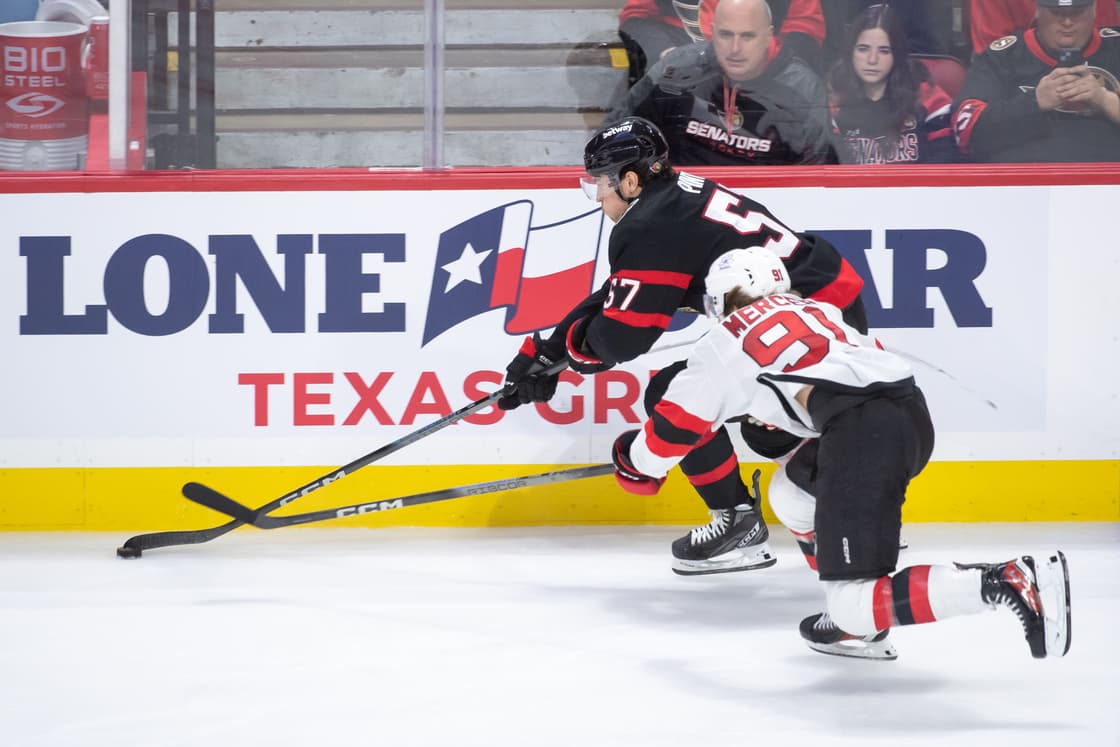
Shane Pinto, Ottawa Senators
Age: 24
Contract: $3.75 million cap hit, RFA in 2026.
Okay, this one is up there with Mercer as the least likely option. But I think this would be a better fit than Mercer.
With Mercer, you don’t know yet what he’s going to be. Is he going to develop into a center? Winger? What kind of production will he have?
But Pinto is a solid centerman with potential to grow into a second-line role. He’s got the tools to be a scorer, and he has size, and he uses it. I loved watching him get his first taste of playoff action with the Sens this year. He’s a gamer.
So I’ll ask the same question as Mercer, why would he ever even be available?
I wonder about his future in Ottawa. He’s stuck behind Tim Stutzle and Dylan Cozens on the depthchart,t and the Sens also have Ridley Greig capable of playing 3C for the foreseeable future. I wasn’t as worried about his place with the Sens when Josh Norris was the 2C. But since Norris was traded for Cozens, it becomes harder to find a route for Pinto to get to the top six.
He’s got one year remaining at $3.75 million before being due a raise. Pinto is an ideal 3C and can develop into that future 2C for Colorado after Nelson is gone, if not during Nelson’s three-year tenure. He’s young enough where playing the long game with him makes sense, but he’s also a valuable player now. He also shoots right, like Coyle.
If the Avalanche went after Pinto, it would likely be part of a bigger deal. Perhaps one involving Necas if he doesn’t re-sign with Colorado. Ottawa has Claude Giroux and David Perron in the top six, they could use someone like Necas in the coming years. And might be willing to offer him a crazy amount of money. This would also mean Colorado needs to look elsewhere to replace Necas in the top six. Perhaps they can do that by using the other assets they’d receive from Ottawa in this made up trade scenario.
Like I said, I’m getting a little crazy with this one and would consider it the least likely option. But it’s still fun to consider.