
 Terry Frei
This will be the Avalanche’s third appearance in the Stanley Cup Final — and the first in 21 years.
I bet you knew that.
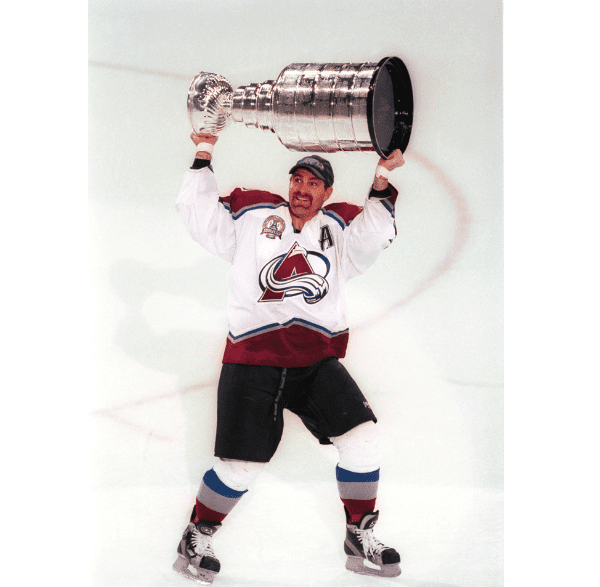
You knew that even if, as was Avalanche defenseman Bo Byram, you were born after the Cup in quick handoffs went from NHL commissioner Gary Bettman to captain Joe Sakic, to iconic defenseman Ray Bourque on the Pepsi Center ice after Game 7 against the Devils on June 9, 2001.
In Byram’s case, he was born four days later. Yes, his milestone 21st birthday is Monday.
Adrian Dater and I are among those who covered the two previous Final appearances.
My NHL coverage resume also includes five seasons as a beat writer chronicling the often bizarre saga of the Colorado Rockies before their 1982 sale and move to New Jersey. The most games the Rockies ever won in a regular season was 22 (in the tie era, they did have 21 ties in one season) and made the playoffs only once. That first-chance futility is part of the Avalanche context.
Each of the Avalanche’s three Stanley Cup Final appearances has a distinct and unique narrative. I’m not necessarily talking about only on-ice events, but more about the Colorado hockey times tied to each berth in the Final — and the two championships so far.
In 1995, the Nordiques landed in Denver as a ready-made championship contender, and at the time, the list of Colorado’s major-league (i.e., NFL, NBA, MLB and NHL) champions was as follows:
(None.)
The Broncos had been to four Super Bowls and lost them all. The first appearance, in January 1978 against the Cowboys, was an anticlimax following a celebrated ’77 season and AFC playoff wins over the Steelers and the hated Raiders at Mile High Stadium. But the other three Broncos losses in the Super Bowl spotlight — to the Giants, Redskins and 49ers — were considered disappointments … and even, to varying degrees, embarrassments.
Indeed, the back-to-back Super Bowl wins after the 1997 and ’98 regular seasons still were a few years off for the Broncos when the Avalanche knocked off the juggernaut Red Wings in the 1996 Western Conference Final, then swept the surprising Florida Panthers in the Stanley Cup Final.
Colorado’s first major-league championship came from the upstart, recently arrived franchise with a history that dated back to both the WHA and NHL as the Quebec City-based Nordiques. I had made several trips to Quebec to cover Rockies-Nordiques games after four WHA teams moved to the NHL in 1979, but had no idea the team with the legendary toasted hot dogs in Le Colisee would end up moving to Denver.
In 1995-96, cynics in the hockey world sarcastically portrayed Colorado fans as long-suffering, as having to wait months — months! — to be part of a Stanley Cup celebration. That was oversimplification and even ignorance, given Colorado’s deep-rooted hockey history with college hockey at DU and CC, several forays in pro minor leagues (most notably the Denver Spurs in the Western Hockey League) and the WHA.
But it would be ludicrous to try to pretend that the arrival of the Avalanche wasn’t an amazing stroke of fortune for Colorado. The impressive largely young core included Sakic, Adam Foote, Peter Forsberg, Valeri Kamensky and many more. Then quickly came the acquisitions of Claude Lemieux, Sandis Ozolinsh and a volatile goalie named Patrick Roy.
“We had such a good fan base in Quebec and felt for everybody there,” Sakic told me years later in an omnibus magazine interview. “I think [Nordiques owner] Marcel Aubut and [GM] Pierre Lacroix called me in May, right around the time we finished in the playoffs. I think we all visited Denver the July 4 weekend to look around and check out McNichols Arena at that initial kickoff. We didn’t even have a name yet.
“We were pretty amazed with the city, flying in and seeing the mountains. Actually, we had played an exhibition game – I think it was 1990 – against the Kings at McNichols Arena. So, I’d been there before. But when we got here, we were excited, and we knew we had a young team and a good team. We were coming here to get to the next level after losing in the first round as the No. 1 seed. Now, we heard that the fans were excited, but we didn’t realize what it would be like right from day one… With all that excitement and us being a new group, it was an amazing season.”
During that 1996 Final appearance against the overmatched Panthers, the bond of affection between the Avalanche and the market still was being established. New fans climbed aboard the bandwagon for both the franchise and the sport. Fans of other NHL teams in this transplant market switched affections or added to them. When Uwe Krupp scored in the third overtime to give the Avs the series-ending 1-0 win in Game 4, the party was on. It included a gathering at the packed Civic Center Park and a parade through downtown — prototypes for Broncos celebrations a few years later.
By the 2001 Stanley Cup Final, the newness and even naivete largely had worn off.
There even had been disappointments, including back-to-back Game 7 losses to the Dallas Stars in the Wester Conference Final in 1999 and 2000. Years later, in fact, Sakic later conceded in that interview that the Avalanche might have left at least one additional championship “on the table.”
Make no mistake, by that second Final appearance, fandom was impressively fervent, but it was just different.
Colorado’s development as a hockey territory — with rink construction and burgeoning youth and hockey participation, from organized leagues to drop-in games over the lunch hour — was in high gear. So was the building savviness of the fan constituency. With each passing year, you were less likely to hear a knowledgeable hockey fan (male or female) explaining the rules on a first date and more likely to hear lines quoted from “Slap Shot” or the the breakdown of which Avs played major junior, NCAA or European pro hockey on the way to the NHL.
The Avs were expected to win. They hadn’t acquired, among others, Bourque and Rob Blake to do anything else. This time, it was no Cinderella, upstart story of a relocated franchise and a new market getting its second NHL chance, 13 years after the Rockies’ departure. And in 2001, they pulled it off, coming back from a 3-2 Final deficit — largely because on Roy’s phenomenal play at the outset of Game 6 — to claim the Stanley Cup. To this day, the most vivid memory is Sakic handing Bourque the Cup he had waited so long to hoist.
Sakic told me he approached Bourque on the flight back to Denver after Game 6.
“I just went up to Ray and said, ‘Hey, we have a …’ He cut me off and said, ‘No, no, no.’ He was superstitious. I wasn’t a superstitious guy. I was like, ‘All right.’ But when we won, I knew Ray was getting the Cup first. After the game, I really didn’t know what I was going to do, other than he was going to be the next to have the Cup. Once we won, I guess it was the moment, there he was. I didn’t think about it, I just handed it over to him as quick as I could.”
Sakic laughed, then added: “If it was the very first time I had won it, he probably wouldn’t have had it. I would have made sure I lifted it up first. If he was there in 1995-96, there was no way I would have done that. I have to come clean.”
I asked Sakic if he was amazed how many people remember that as perhaps the defining moment of your career.
“Yeah, a lot of people bring it up as the favorite thing they saw,” he said. “I didn’t really think of it like that. It was, “Here’s a guy who has played for 22 years, a legend of the game, and in the entire playoffs, everybody’s rooting for him.” I just felt it was the right thing to do.”
In the locker room celebration that night, I approached the Avalanche’s new owner, Stan Kroenke. He held a champagne bottle in one hand and leaned over to deliver his message, knowing it was the only way he would he heard.
“Unbelievable year,” he said, hoarsely. “Unbelievable accomplishment. Unbelievable people. Unbelievable players. What can you say about a year like this? How often do you go to a seventh game in the Stanley Cup, then you win it in front of the home fans? Unbelievable!”
OK, so now we flash forward 21 years.
A generation.
Avalanche players mostly now politely play along with vague, one-size-fits-all answers when we ask them about the franchise’s traditions, whether the Blood Feud rivalry with the Red Wings or the two titles and the great players who came before them.
Sakic still is “Joe,” but he’s more the boss and GM than he is the Hall of Famer.
Colorado has matured even more as a hockey market. DU and CC can have Coloradans on their rosters and elite youth hockey is widespread. The Avalanche’s relocation of their AHL affiliate 50 miles up Interstate 25 to Loveland has been successful at the box office, in part because of the Eagles’ surprisingly interest-building-runs in the CHL and ECHL.
Who would have thought that after a long list of folded minor-league ventures in the state, hockey would be a hit in Northern Colorado?
After a false start with the 112-point season in 2013-14 and then a horrific 48-point disaster in 2016-17, the 2021-22 Avalanche roster has been rebuilt around holdovers Erik Johnson, Gabriel Landeskog, Nathan MacKinnon, Mikko Rantanen and J.T. Compher. With Cale Makar — gee, what rotten luck the Avalanche had in having to settle for the fourth overall pick in 2017! — already drawing favorable comparisons to Bobby Orr, the likelihood is this will be only the first of multiple Final appearances in upcoming seasons.
Each run to, and in, the Final has its own story. This year’s is in progress.
Terry Frei ([email protected], @tfrei) is a Denver-based author and journalist. He has been named a state’s sportswriter of the year seven times in peer voting — four times in Colorado and three times in Oregon. His seven books include the novels “Olympic Affair” and “The Witch’s Season.” Among his five non-fiction works are “Horns, Hogs, and Nixon Coming,” “Third Down and a War to Go,” “March 1939: Before the Madness,” and “’77: Denver, the Broncos, and a Coming of Age.” He also collaborated with Adrian Dater on “Save By Roy,” was a long-time vice president of the Professional Hockey Writers Association and has covered the hockey Rockies, Avalanche and the NHL at-large. His website is www.terryfrei.com and his bio is available at www.terryfrei.com/bio.html
His Colorado Hockey Now column archive can be accessed here