
 Ryan Boulding
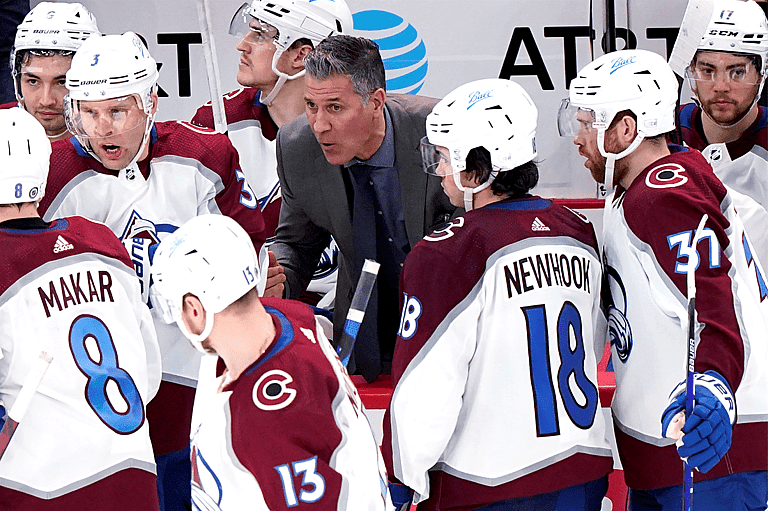
Since we were on the topic, and because the team and players and local media had made the trek down to Ball Arena on Easter to watch practice and pick the mind of the winningest coach in Avs history, it was only natural for us to swim away from the Cale Makar for Norris Trophy exploration and dive into what Jared Bednar’s views on coach of the year are.
Spoiler alert: he doesn’t think he’s worthy.
Humble and focused on the true task at hand—which is winning the Stanley Cup, in case you’d forgotten—Bednar was quick to praise others around the league for what they’ve done this season and over a protracted period of time, responding with a reasoned exploration on whether the Jack Adams Award should be (and is) about a single season’s success versus legacy accomplishment.
“I do think that a lot of times it’s sort of like the surprise team. Like I was up for it a couple years ago, right, because everyone had us pegged at the start of the year as a team that would get 70-something points or whatever and we finished with 90,” Bednar said. “But I think it’s equally as tough a job to take a team from exceeding expectations to being like Jon Cooper, who has a good team and coaching all these different pieces and still being able to like keep them at the top for as long as he can. I don’t think those guys get enough credit.”
So how does he see this year breaking down?
“It’s different criteria for everyone. There’s a good argument,” Bednar said. “I look at Todd McClellan with the Kings, and it’s kind of the same thing. They didn’t expect him to be where they are, and I think he has a great case for being coach of the year. Darryl Sutter, huge turnaround in Calgary, right? Then you got guys that are leading the charge, like Florida. You got Tampa right there again. You’re not sitting in a playoff spot unless you’re doing a good job with your team, and it’s not easy, right? There’s 16 really good teams, minimum, that are going to be making a push for the Cup, and you’re facing good opponents every night.”
In case you’re wondering, Bednar doesn’t think he deserves it this year and hasn’t earned it previously, despite what he’s done for a team that bottomed out in 2016-17 when he was essentially an emergency replacement for Patrick Roy, who departed abruptly and without warning.
(I maintain that Roy winning the Jack Adams in 2014 before seeing his team spiral down to failure really had an impact on how people view the coach of the year accolade, as you hope it’s more than a one-hit wonder of a year. That’s where the legacy-of-success concept comes in.)
Still, in this instance Bednar is certainly wrong. He is deserving for recognition at a minimum, and it’s not because he doesn’t think he deserves it. Instead, it’s due to how he’s set about coaching the game and his overall impact on how the game is being coached since he joined the league.
“There’s always a lot to learn. The game is always changing. For example, a couple of years ago, we started running our three-high cycle a lot when we got some pieces on the ‘D’ and MacKinnon would always be rolling high,” said Bednar. “We didn’t see a lot of teams doing that. In the American League we had a couple. We started running it here, and we had a ton of success and we were creating like crazy on it.”
“Well now teams have figured out how to defend it. Other teams are doing it all the time now, too. Every team we play is running a three-high cycle with three and four guys up there and then creating offense out of that. And as teams get better at defending it, which we play some teams that are really good at that, then you got to go back and have some balance in your game. You got to be able to work the low cycle and create with an F3 down low and be scissoring and picking and all that. I felt like it was easier at times to create when we first started it than it is now. Now we have to keep adjusting. So you’re always kind of looking at where the trend’s going and where the openings are.”
I know what you’re saying. Just because he ran a system people weren’t using doesn’t make him the reincarnation of Jack Adams. Just because he adapts away from a game plan that’s been solved doesn’t make him Scotty Bowman. You’re right. It doesn’t. But it’s desire to innovate, adapt, recycle, reuse, and succeed with the pieces he has that makes Bednar so impressive.
“You’re always sort of paying attention to it and seeing what other teams are doing. Even players are doing it. They’ll watch. Like [Gabriel Landeskog] will come in, ‘Hey did you see that faceoff play that Boston ran?’ Then we’ll just pick it apart and look at it and talk about it, and if it works we’ll implement it. It’s a copycat league. It just kind of goes around and around. And then things get forgotten about for a while. So you’re always kind of recycling on things, even [like] we did here at the start that we’ve kind of moved away from. That’s where your experience comes in.”
“What have I learned? It’s your experience and you learn where you’ve kind of had success in places and things that worked at one point, then they don’t. Well what’s your next step? Where are you going from there? And I think that helps. And having guys like [Nolan Pratt] and Ray [Bennett], a guy that’s been around forever. You’ll learn a lot from those guys and everyone’s just kind of bouncing ideas off. But I would say continuously you’re [looking for a new system]. Especially when things aren’t going good.”
That’s a pretty good case for me. And you heard it here first: Gabriel Landeskog could have a future in coaching after his playing days are done.
Just so you know, the last five Jack Adams Award winners have been Rod Brind’Amour, Bruce Cassidy, Barry Trotz, Gerard Gallant, and John Tortorella.
In 2020-21, Brind’Amour won with a 36-12-8 record for 80 team points. Cassidy took it home in 2019-20 with a 44-14-12 record worth 100 team points. Trotz won with the New York Islanders in 2018-19 (after having won with the Washington Capitals in 2015-16) with a 48-27-7 record good for 103 points. Gallant and his expansion Vegas Golden Knights went all the way to the Stanley Cup Final in 2017-18, and he won the regular-season coaching award with a record of 51-24-7 that netted 109 team points. Torts claimed the title with the 2016-17 iteration of the Blue Jackets when he had a 50-24-8 record that took home 108 points.
As of publication, the Avalanche sit at 55-16-6 with 116 points and five games left before the start of the playoffs. If the Avs were to win out, they’d record just the fourth 60-plus win season in NHL history.
The last team to do it was the Tampa Bay Lightning in 2018-19, a year when Cooper—who hasn’t won coach of the year somehow—didn’t win coach of the year somehow after stringing together a 62-win season.
The other two clubs to achieve the feat are the 1995-96 Detroit Red Wings (insert Avalanche fan smirk here) and 1976-77 Montreal Canadiens. Both teams were coached by Bowman and he won the best bench boss award each time.
Fun fact: Only one NHL head coach has won the Jack Adams Award three times. His name is Pat Burns. Jacques Demers, Pat Quinn, Bowman, Jacques Lemaire, Tortorella, and Trotz have each won twice.